FilmWatch a pull request get reviewed

Ship fast.
Don’t drift.

Tently reviews every pull request against the decisions your team already made and the callers the diff never touched, and answers Claude Code, Cursor and Codex while they write.

1,522 developers on the waitlist · Already have access? Sign in

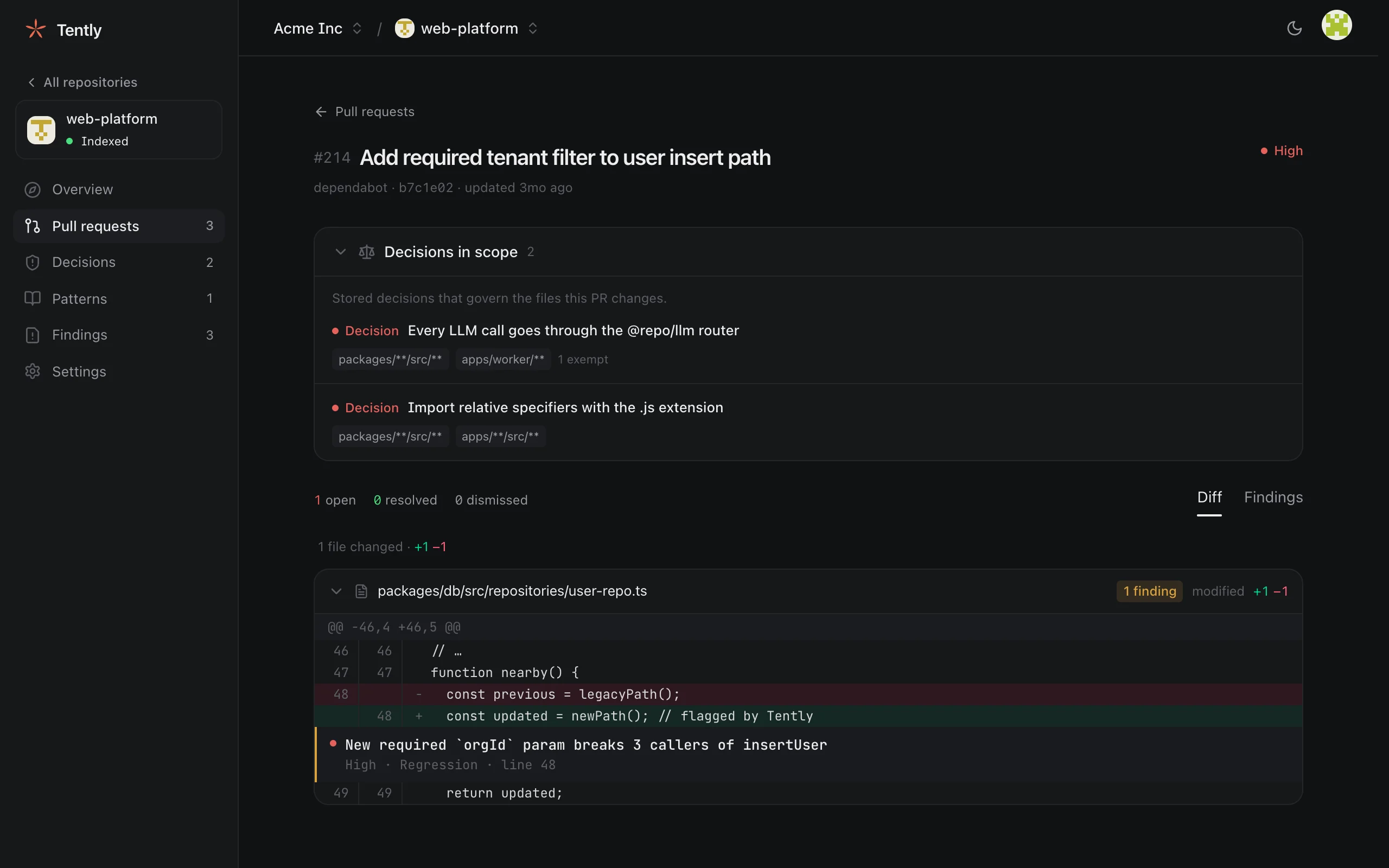
app.tently.dev/acme/web-platform/prs/214
Pull request #214 in Tently: two decisions in scope and a regression finding inline in the diff

One store, two gates.

Install the GitHub App once. Tently learns what your team decided, then holds every change to it: your coding agent asks while it writes, and the pull request check enforces it before anything merges.

  1. 01Learn
  2. 02Write
  3. 03Map
  4. 04Review
  5. 05Ratify
Learn01 / 05

Mined, not written.

Tently reads your merged pull requests, past review threads and docs like ADRs, READMEs and CLAUDE.md, then proposes the decisions your team already made.

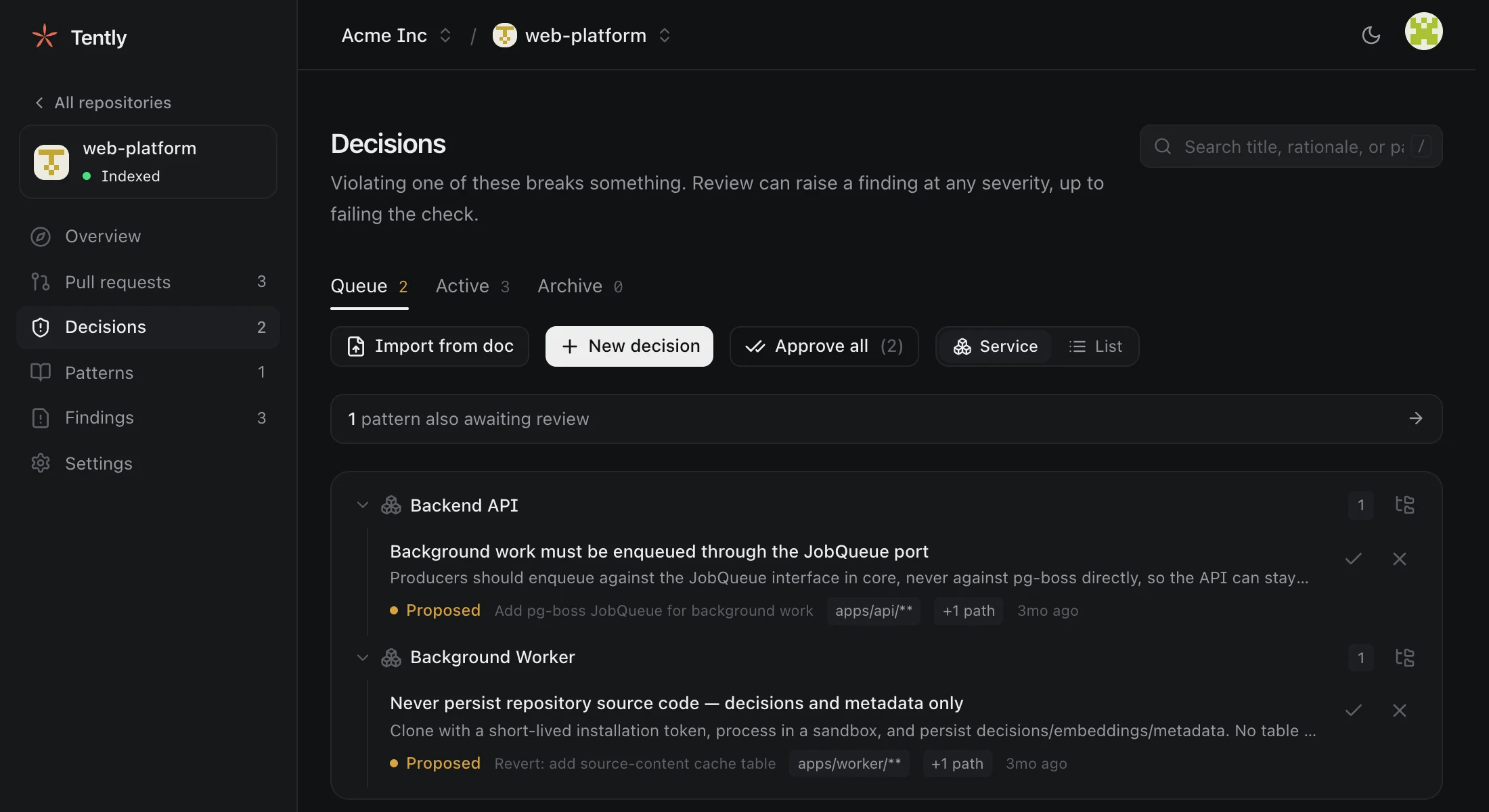
● Proposed Background work must be enqueued through the JobQueue port
Write02 / 05

Asked while it writes.

Gate one. Your coding agent asks Tently over MCP before it changes a file, and checks the impact of a change on your working tree, which never leaves your machine.

$ npx @tently/mcp init → search_decisions · query_impact_zone
Map03 / 05

Every caller, traced.

On every pull request Tently builds a code graph from a fresh clone and follows each changed function, type and export to the code that calls it, inside the diff or not.

insertUser() · 4 callers · 3 break outside the diff
Review04 / 05

Checked before merge.

Gate two. Verified findings land on the pull request as a check run and inline comments, evidence attached. Make the check required and a regression can’t merge.

Tently — New required orgId param breaks 3 callers of insertUser
Ratify05 / 05

You keep the rules.

New decisions from merged work come back as proposals for your team to approve, edit or reject. A pull request still under review never creates one.

Queue 2 · Active 3 · Archive 0 Approve all (2)

Regressions

It reads the code the diff never touched.

A signature changes in one file and three callers break in three others. Tently follows each changed symbol through the code graph to its callers and entry points, then reads them to decide what really breaks.

Watch it catch #214
Blast radius · insertUser4 callers · 3 break · 3 entry points affected
changedcallersentry pointsuser-repo.ts:48insertUser()− db, input+ db, input, orgIdsignupHandler()routes/signup.ts · no orgIdPOST /v1/signupacceptInvite()routes/invites.ts · no orgIdPOST /v1/invites/:idseedWorkspace()jobs/seed.ts · no orgIdjob · seed-workspaceadminCreateUser()updated in this PRadmin console

Callers outside the diff

Every changed function, type and export, traced to the code that calls it.

Evidence attached

A finding names each impacted symbol and file, or links the decision it breaks.

Decision drift

A change that goes against a decision cites it, with a link to where your team made it.

Zero is not proof

No callers in the graph? Tently still searches the code and reads likely consumers.

Severity and confidence

Regression or drift, critical to info, with a confidence score on every finding.

Patterns stay low

Conventions worth following. A finding that cites only a pattern is capped at low severity.

The product

Built around your decisions.

A decision store your team approves, a gate in your coding agent, a check on every pull request, and findings that earn their place.

The decisions queue: proposed decisions mined from merged pull requests, grouped by service

Decisions, mined and approved.

Each decision has a rationale, a scope of paths and a link to its source. Approve, edit or reject; approved decisions become what every review checks.

Gate one: while the agent writes.

npx @tently/mcp init connects Claude Code or Cursor. Impact checks run on your working tree, so the source never leaves your machine.

Gate two: the PR check.

A check run and inline comments on every pull request. Make it required and a regression can’t merge.

Quiet by design.

A stronger model confirms each finding before it posts. Your feedback tunes it, and dismissed stays dismissed.

Runs alongside your reviewer.

Keep CodeRabbit, Copilot or cubic for the diff. Tently covers what lives outside it.

Copies of your source code we keep: zero.

Each review clones your repository into a sandbox with an installation token that expires within the hour. When the review ends, the sandbox is destroyed. What stays is decisions, findings and feedback.

ephemeral

Cloned, then deleted

Each review runs on a fresh clone in a sandbox that is destroyed when the review ends.

least privilege

Short-lived tokens

Installation tokens expire within the hour. Tently writes only PR comments and check runs.

isolated

Row-level tenancy

Every query is scoped to your organization by Postgres row-level security.

metadata only

Decisions, not source

What persists is the decision store, findings and feedback. Never your files.

Read how we handle your data in our privacy policy

The film · 1:43

Watch #214 get reviewed.

A pull request, checked against the decisions it was about to break.

The Tently launch film · 1:43

Pricing

Priced per pull request, not per seat.

Plans include pull requests reviewed each month. Seats, repositories and the MCP gate are unlimited on every plan.

How PRs are counted

Solo

Try Tently on your own repos.

$0 /month

30 PRs a month, then reviews pause

Request access
  • Regression + drift PR review
  • MCP write-time gate
  • Unlimited seats and repositories
  • In your personal workspace

Fleet

Org-wide institutional memory.

$399 /month

1,000 PRs a month, then $0.40 each if you turn it on

Request access
  • Everything in Crew
  • Extra PRs at $0.40, capped by you
  • Shared Slack channel

Already in? Pick a plan on the Billing page of your dashboard. Annual billing or self-hosting? Write to [email protected].

Questions

Anything else? Write to [email protected].

Does Tently replace my current AI code reviewer?

No. Tently looks for regressions and decision drift, the problems diff-only reviewers miss. Keep CodeRabbit, GitHub Copilot or cubic for what’s inside the diff; Tently runs next to them.

Do I have to write rules?

No. Tently mines decisions from your merged pull requests, review threads and docs such as ADRs, READMEs and CLAUDE.md files. Your team approves, edits or rejects each proposal. You can also write one by hand or import it from a document.

Does Tently keep a copy of my code?

No. Each job clones the repository with a short-lived installation token into a temporary workspace, which is deleted when the job finishes. Tently keeps decisions, findings, embeddings of decisions, repository metadata and your team’s feedback.

What can the GitHub App write?

Pull request comments and check runs. Nothing else.

Can a finding block a merge?

Yes, if you make the Tently check required in your branch protection rules. A pull request with a regression then can’t merge until it’s fixed.

Which coding agents work with Tently?

Any MCP client. Run npx @tently/mcp init in your repository with an API key from the dashboard: it sets up Claude Code and Cursor directly, installs a skill that says when to call search_decisions and query_impact_zone, and backs up any file before it changes it. Codex and other MCP clients connect to the same server.

Which model reviews my code?

By default, requests go through OpenRouter to Anthropic. A workspace can add its own OpenRouter API key instead. Tently doesn’t train models on your code, decisions or findings.

How do I get access?

Tently is in early access for teams on GitHub. Join the waitlist with your work email and we’ll be in touch.

Ship fast.
Don’t drift.

Tently is in early access for teams on GitHub. Join 1,522 developers on the waitlist.

# once you’re in: connect your coding agent
$ npx @tently/mcp init
✓ registers the Tently MCP server
✓ installs a skill for search_decisions
    and query_impact_zone
✓ backs up any file before it changes it